Benchling (@benchling) header
Benchling (@benchling) profile picture

On a mission to unlock the power of biotechnology and empower our global customers to get to milestones and market faster. Academics join for free! 🧫🧬👩🏻‍🔬

San Francisco, Boston, Zurich
Joined June 2012
Photo by Benchling (@benchling)Photo by Benchling (@benchling)Photo by Benchling (@benchling)Photo by Benchling (@benchling)Photo by Benchling (@benchling)Photo by Benchling (@benchling)Photo by Benchling (@benchling)Photo by Benchling (@benchling)Photo by Benchling (@benchling)Photo by Benchling (@benchling)
What does it mean to be on #TeamScience? Find out what Benchlings have to say about our mission and culture — and above all, why we’re so passionate about helping scientists power new possibilities for humanity. youtu.be/KiBmXAGoMgU
9
9
40
Benchling retweeted
A trifecta of greatness: @benchling @appliedcompute @nvidia . Congrats to @nlarusstone and the team at Benchling!
What if your company’s own scientific data could help you build specialized models that outperform the frontier? Introducing Benchling Specialized Intelligence, to help biopharma companies do just that. With @appliedcompute and @NVIDIA, we post-trained Kimi K3 on 2,000 tasks from real experiments. It beat the strongest frontier model by 11 percentage points on our wet lab troubleshooting benchmark. benchling.com/blog/a-bluepri…
1
2
18
1,307
Benchling retweeted
Frontier LLMs have learned biology from published knowledge, not the decades of experiments inside biopharma companies. With @appliedcompute and @nvidia, we explored what happens when models learn from proprietary data. We trained Kimi K3 on 2,000 tasks from real experiments contributed by experts. It reached 71.8% on our wet lab benchmark, 11 points above the strongest frontier model tested. Now we’re helping biopharma train models on their own data. More here: benchling.com/blog/a-bluepri…
3
2
1
24
2,165
Benchling retweeted
Life sciences is one of the clearest areas where some of the world's most valuable data remains out of distribution. Great work from @caenopy in collaboration with @benchling to train a SoTA model!
More than 1,300 biotech and pharma companies use @benchling to manage scientific data and workflows. General purpose models struggle to reason through routine wet lab tasks because most of how scientists fix failed protocols is never published. We post-trained an open-weight model on Benchling's tasks that scored 71.8% on BenchBench-Protocol, 11.3 points above the strongest frontier model evaluated.
7
9
232
18,530
Had a lot of fun talking to @caenopy about the work we did with @appliedcompute to train the world's best model at protocol optimization! We talk about why we think protocols are a good proxy for biological reasoning and the opportunities for pharma companies to own their own intelligence.
1
2
11
462
How much better can models get when trained on real scientific data? A lot. With @appliedcompute and @NVIDIA, we boosted Kimi K3's score on our wet lab troubleshooting benchmark by nearly 25 percentage points, putting it ahead of the strongest frontier model. benchling.com/blog/a-bluepri…
2
8
2
36
2,026
More than 1,300 biotech and pharma companies use @benchling to manage scientific data and workflows. General purpose models struggle to reason through routine wet lab tasks because most of how scientists fix failed protocols is never published. We post-trained an open-weight model on Benchling's tasks that scored 71.8% on BenchBench-Protocol, 11.3 points above the strongest frontier model evaluated.
5
8
9
106
39,558
What if your company’s own scientific data could help you build specialized models that outperform the frontier? Introducing Benchling Specialized Intelligence, to help biopharma companies do just that. With @appliedcompute and @NVIDIA, we post-trained Kimi K3 on 2,000 tasks from real experiments. It beat the strongest frontier model by 11 percentage points on our wet lab troubleshooting benchmark. benchling.com/blog/a-bluepri…
11
9
3
108
13,170
Benchling retweeted
Applications for re:AGENT II close Dec 11. Teams of scientists and builders will spend January 9–10 in SF building an AI Scientist, an AI Clinical Developer, or AI for Patient Access. Each track has a cash prize, including a separate Eval Prize! Apply now. The link is in the comments. @AnthropicAI , @modal , @benchling , @biohub , @strandaibio, @benchflow_ai, @FenwickWest , @arcinstitute, futurebio
1
8
1
11
2,963
30 days, 30 agents megathread. What I don't understand is why every biotech doesn't have some form of this already running for them. Literally takes <15 min to set up an agent (you can steal my prompts)! Lots of excitement around parsing CRO data and TPP literature review, but also deviation triage and CAPA agents. Full list here: 1. Status report/slides (weekly) 2. Hypothesis dreamer (weekly) 3. Control chart agent (weekly) 4. Experiment planner (daily) 5. Literature review (weekly) 6. In vivo study design review agent (study phase change) 7. Equipment maintenance monitor (weekly) 8. Notebook reviewer (entry review status change) 9. Patentable discoveries (monthly) 10. Inventory re-ordering (daily) 11. Data QC for a program (daily) 12. CRO file -> analysis pipeline (file creation) 13. Auto-unblock analysis (analysis status change) 14. Competitive intelligence review (weekly/monthly) 15. Program manager (daily) 16. Wiki updater (daily/weekly) 17. Put attachments into structured tables (daily/weekly) 18. Dataset builder (weekly/monthly) 19. Sequence QC (daily) 20. Workflow updater (daily) 21. TPP literature check (custom entity creation) 22. Data model governance (weekly/monthly) 23. Deviation/CAPA triage (custom entity creation) 24. Protein -> structure prediction (AaSequence creation) 25. Instrument parser (file creation) 26. Experiment duplicate checker (entry creation) 27. Scientific skeptic (weekly) 28. Curve selection concordance analysis (weekly) 29. Developability liability flagger (AAsequence creation) 30. Agent manager (weekly)
5
4
1
25
1,962
Congratulations to @boltz_bio on their $110M Series A! We've seen firsthand the enthusiasm for Boltz among Benchling users. Love seeing the AI biology ecosystem grow, and looking forward to supporting more of it! endpoints.news/ai-bio-startu…
2
25
1,354
Benchling retweeted
We’ve raised $110M in a Series A led by Bessemer Venture Partners to bring AI-powered biomolecular design to every scientist! 6 of the world’s top 20 pharma companies are partners. Molecular token usage has grown 50-fold since June. boltz.com/series-a
We’ve raised $110M to bring AI-powered biomolecular design to every scientist! Boltz’s Series A is led by @BessemerVP, following 50-fold growth in molecular token usage from our users since June and partnerships with 6 of the world’s 20 largest pharma companies.
4
12
4
70
5,089
We’ve raised $110M to bring AI-powered biomolecular design to every scientist! Boltz’s Series A is led by @BessemerVP, following 50-fold growth in molecular token usage from our users since June and partnerships with 6 of the world’s 20 largest pharma companies.
92
76
35
705
73,567
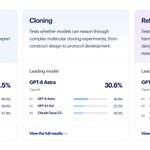
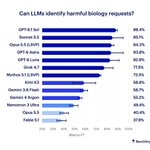
How do GPT-6.2 Astra and Sol perform on real scientific tasks? Astra now leads our benchmark for molecular cloning tasks at 56.0%, 15 points ahead of Claude Mythos 5.2. Sol is second at 44.6%. On protocol design and refusal behavior, both score slightly below the models they replace. See our updated BenchBench leaderboards: benchling.com/benchbench?utm…
1
10
801
New GPT6.2 models! Strangely they got much better at cloning but no real improvement on protocol design/optimization... Goes to show that intelligence is still quite spiky, especially in the biology domain. Also slight regression on overrefusals, but still pretty well calibrated there
3
1
20
1,704
Day 30!!! We made it. Day 30 of “An agent a day keeps Phase 2 failures away” — agent manager Once you’ve set up many agents you start to run into a new problem: managing them. Are they working? Is the work they’re doing useful? The real solution is to group agents together into Science Foundries, but that’s a topic for another day… Today we’ll just set up your personal chief of staff — an agent which monitors all your other agents and ensures they’re working as expected. Sample prompt (feel free to tweak): Create an Agent Manager agent which runs every week. Review all of my other agents and their recent runs to assess which ones are working well, which ones are failing or getting stuck, and which ones could be improved. Look for recurring errors, missed triggers, unnecessary work, excessive costs, and places where agents are duplicating each other's efforts. Evaluate whether each agent is actually accomplishing its intended goal, not just completing its runs. Give me a concise report highlighting the biggest issues and opportunities, with concrete examples and recommended changes. Prioritize improvements by their expected impact, and ask for my approval before making any changes to existing agents.
1
1
6
444
Day 29 of “An agent a day keeps Phase 2 failures away” — developability liability flagger The earlier you can identify a drug candidate might have developability issues, the better. There are certain deterministic aspects you can flag in addition to running predictive models. And then you can set up an agent which actually records those flags directly in the candidate so that everyone can benefit from them and work with the same information. Sample prompt (feel free to tweak): Create a Developability Liability Flagger Agent which runs every time an amino acid sequence is registered. Screen for deamidation (NG, NS, NT, NN, NH), Asp isomerization (DG, DS, DD, DT, DH), N-glycosylation sequons (N-X-S/T, X≠P), potential unpaired cysteines or disrupted disulfides, Met/Trp oxidation, cleavage/fragmentation sites, glycation, and terminal processing; distinguish expected or engineered features from concerns. Run our solubility and all other applicable prediction models to assess aggregation, exposed hydrophobic and charge patches, self-association, viscosity, folding/thermal stability, nonspecific binding/polyreactivity, expression/assembly, and immunogenicity indicators, including format-specific risks where relevant. Prioritize findings using structural exposure, CDR/paratope location, paired-chain context, and available expression/formulation conditions. Mark any flags or concerns directly on the registered sequence.
2
1
10
714
How good is AI at extracting structured data from scientific documents? We built BenchBench-Data Import to find out. The latest models now achieve over 80% accuracy, compared to just 50% for older models. See the results: benchling.com/benchbench/dat…
2
380
Day 28 of “An agent a day keeps Phase 2 failures away” — curve concordance analysis Every scientist likes to call curves slightly differently. If your assay isn’t noisy (and we know how often that’s the case), that might not be an issue. But once you start running many assays across many different scientists and teams, this becomes a much larger problem. These decisions add up and can have surprisingly large consequences for which molecules advance. Let’s set up an agent which looks over those decisions, helps compare them across scientists, and improves our overall data hygiene. Sample prompt (feel free to tweak): Create a Curve Concordance Agent which runs every week and looks over all of the dose response curves that have been recorded. Look at the raw data, fitted curves, and which curves and data points scientists have chosen to include or exclude. Compare those decisions across scientists, experiments, and historical results to identify inconsistencies. Pay particular attention to cases where different curve selections would meaningfully change the reported potency, hit classification, or candidate ranking. For any disagreements, investigate why they occurred, show how the different choices affect the scientific conclusions, and recommend which ones need human review. If there aren't clear criteria for selecting and rejecting curves, look at historical decisions, propose a consistent set of rules, and ask the team to review them. Don't automatically change any approved results.
2
1
7
504
The second most expensive experiment is the one run against the wrong hypothesis. Good science requires skepticism to challenge obvious assumptions and get to the underlying truth. All too often, though, it’s easy to just keep doing what you’re doing and not challenge your own beliefs. And even if you do, you have your own biases that often get in the way. Let’s set up the perfect research skeptic: an agent which can process huge amounts of data and has no emotional attachment to your current research directions. Sample prompt (feel free to tweak): Create a Scientific Skeptic Agent which runs every week and looks over all of the ongoing work for me and my team, identifies unsupported assumptions and alternative explanations, and proposes experiments designed to falsify them. If there are no explicit hypotheses or overall experimental directions written somewhere, then write them down explicitly and ask the relevant people to review them. If there are, refer back to them as guidance for how to direct your skepticism. Day 27 of “An agent a day keeps Phase 2 failures away” — scientific skeptic
5
1
18
850