Michael Santarcangelo (@catalyst) header
Michael Santarcangelo (@catalyst) profile picture

Deliver value that gets recognized — because that's what people pay for. Operator • Trusted advisor • Close Counsel Founder of ValueSmith™.

Tampa, Florida
Joined March 2007
Photo by Michael Santarcangelo (@catalyst)Photo by Michael Santarcangelo (@catalyst)Photo by Michael Santarcangelo (@catalyst)Photo by Michael Santarcangelo (@catalyst)Photo by Michael Santarcangelo (@catalyst)Photo by Michael Santarcangelo (@catalyst)Photo by Michael Santarcangelo (@catalyst)Photo by Michael Santarcangelo (@catalyst)Photo by Michael Santarcangelo (@catalyst)Photo by Michael Santarcangelo (@catalyst)
We’re told we can’t say no, but we don’t know what yes looks like.
60
Drawing new bounds creates new visibility. And new invisibility.
69
Before we ask why they don’t get it, what if they do—and they’re right?
36
Seeing a gap gives us something to consider, not necessarily something to fix.
38
Healthy friction gives us pause to think clearly and make better decisions.
42
People see our capability and competence. How often do they ask about our capacity?
48
Did leadership buy into the idea—or the cost, effort, and time to make it happen?
70
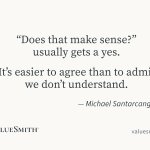
“Does that make sense?” usually gets a yes. It’s easier to agree than to admit we don’t understand.
62
Michael Santarcangelo retweeted
If someone offers to refer you for a job, don't just send them your resume and hope for the best. Find the position you're interested in and ask if they'd be comfortable introducing you to the hiring manager or recruiter. Ask them to copy you on the introduction. Now you know who received your information and can follow up yourself. A referral is a great opportunity. Don't leave the entire process in someone else's hands.
5
4
1
19
1,672
Nodding heads don’t mean shared understanding.
61
The appetite for change doesn’t always match the capacity for change.
1
54
Lead people. Manage process. Boss no one.
58
Our capacity limits what we can do with our capability.
44
We can improve how we communicate. We can't control how someone else responds.
57
Not getting the response we expected can show us what we missed.
48
Becoming a better communicator makes us a better audience.
56
Learning to craft useful messages teaches us to read the situation.
65
What fits in your week? Knowledge work needs time to work. So how do we allocate the limited time and energy we have? I use a model called 20/60/20 with my clients to help us decide where our time and energy go. Here's what it looks like in a forty-hour week. Protect 20% for high-value project work, about 8 hours. High-value work is where we can produce an oversized benefit versus the cost, in the focused time we have. It's a blend of doing good work and finishing it. I recommend scheduling this as three three-hour blocks, usually on Tuesday, Wednesday, and Thursday. And yes, that's 9 hours on the calendar for the math nerds, but in practice, that generally means 6–8 hours of focus each week. For me, that's after the first cup of coffee kicks in, but before the residue of the day builds. That window tends to work for others I work with, too. The point is to give the work that needs our best thinking the time when we can bring it. 60%, roughly 24 hours, goes to operating. Some call it RTB (run the business) or KTLO (keep the lights on). Call it whatever you like. It's where the bulk of our work gets done. Broken up, it's about 4–5 hours a day to handle meetings, status reports, upgrades, and the more routine work and support people count on us for. The key here is energy. While these actions are important (and sometimes urgent), they don't generally demand our best energy. I tend to slot these in for later in the morning and afternoons. The remaining 20% is slack time. No, not for Slack, Teams, or other chats. It's time we deliberately keep open to handle what comes up. This works out to about 1–2 hours each day. It includes time to get from one meeting to the next, give our brains time to reset, and handle the things we didn't anticipate. While we can't always plan for the chaos itself, we can protect time to deal with it. I like printing out a calendar and sketching the boxes by hand, each with a different color. Helps me see what the week looks like, and what fits where. More importantly, it helps me see what doesn't fit. Which forces important questions about where we allocate our time and attention. Instead of trying to take on all the projects, we start to realize three focused sessions a week let us advance 1–2, no more than three. Or we see we have more operational demands than time, creating a new problem to solve. Over time, we start to see our work differently. When faced with new demands, we start to ask where it fits, or what we need to say no to.
58