

Founder, EPB Research. Business cycle research that helps investors separate economic noise from changes that materially alter recession and market risk.
Joined February 2015
- Tweets15.2K
- Following292
- Followers131K
- Likes13.3K





Pinned Tweet
EPB Research tells you when changing economic conditions actually matter for your capital, and what would change the view.
Make fewer costly macro mistakes with your capital.
Start a 7-day free trial here
epbresearch.com/research/?ut…

3
6
8,699
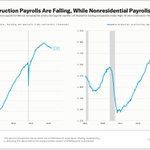
The AI capex boom has created a surge in nonresidential construction jobs.
The multiplier has spread to durable manufacturing production, payrolls, and beyond.
It is understandable that fear of a major AI slowdown (for projects in 2028+) could trigger an economic slowdown, but goods-sector payrolls are more leading, and the income earned from this boom today and over the next few quarters will not unwind immediately.
The tightening in the labor market today will create some upward pressure on inflation.
Stock prices are volatile as earnings growth in 2028+ is discounted today, but it's not quite the same with economic activity, growth, and inflation.
The more near-term risk to the economy is housing, as it's the only sector with measurable, ongoing job losses and activity slowdowns in force today.

Eric Basmajian retweeted
When stocks go down, sentiment gets bearish.
When stocks go up, sentiment is bullish.
Stocks are not a leading indicator.
Trend following is a fine and often successful trading strategy, but it’s not an economic forecasting method.


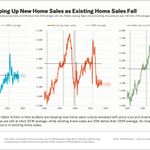
New home sales are at their 2019 average.
Existing home sales are 23% below their 2019 average.
Builders are holding up new sales with price cuts and incentives.

So far, builders have chosen to give up margin rather than cut workers.
With margins now below their pre-pandemic average, the question is how much longer they can keep doing that.
1
5
2,929
We tackle questions like this every week in our free Sunday newsletter.
If you are interested, you can join here: epbresearch.com/newsletter?u…

2,804

Housing took another leg down in October.
Building permits fell to 1.3 million, a new cycle low.
Housing activity will cool further to start 2027.
The major question is what level of employment declines comes with this renewed downturn.

Residential construction activity will turn down again (after a brief stabilization) given the break-lower in new building permits.

NAHB Housing Market Index 25, Exp. 29
How collapsing homebuilder sentiment translates into construction activity and residential job losses remains the key recession risk.
Homebuilder profit margins have absorbed much of the housing downturn since 2022.

More important than the industrial production numbers was the continued collapse in homebuilder sentiment.
How this translates into residential construction activity and residential job losses is the most important question for forward 6-12-month recession risk.

Core inflation bottomed out over the summer and is now rising across all the core baskets.
With key variables like money supply growth and cyclical payrolls growth swinging from contracting to increasing, credible disinflationary forces aren't present.


Employee compensation is 59.6% of US personal income, down from about 73% around 1970.
Transfer payments, dividends, and rental income now make up 31.1%, more than double their share in the 1960s.
A weaker job market hits total household income less than it used to.

Over the last three months, 25.9% of the unemployed found a job each month, up from 24.2% three months ago.
The share of employed people losing their jobs is 0.92%, lower than in 95% of months since 1990.
Hiring is improving slightly. Layoffs remain very low.

Interest rates will only decline sharply when recession risk increases.
Not every stock market decline is a recession.
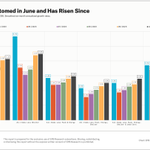
Cyclical payrolls reached another cycle high today.

Initial claims have historically led manufacturing payroll growth.
Claims suggest further gains from here.

