

The leading US-based early stage venture fund focused specifically in industrial biotech manufacturing to accelerate the Material Revolution.
Houston, TX, USA
Joined May 2026
- Tweets119
- Following102
- Followers25
- Likes0







Consumer demand for clean ingredient lists is now mainstream enough to drive a holiday cookbook news cycle, via Fox News. That same scrutiny is coming for the materials in packaging, textiles and plastics, not just the food inside them.
foxnews.com/video/6408637062…

5
TSMC spent $35M just resolving 18,000 work rules at its Arizona fab, and still couldn't find enough electricians and precision technicians. Modular biomanufacturing plants need the same skilled trades. Capital didn't solve TSMC's workforce gap. It won't solve ours either.
23
Expeditionary biomanufacturing doesn't need to beat petrochemical unit economics. It's priced against nothing arriving, or arriving three weeks late through a contested strait.
Source: warontherocks.com/cogs-of-wa…


Companies constantly innovate and redesign their packaging to boost performance, enhance sustainability and improve marketability. Here’s a look at three recent packaging developments on Packaging Dive’s radar.
packagingdive.com/news/packa…

17
The industrial biotech financing gap has a specific shape: plenty of seed capital for strain development, almost none for the first commercial-scale plant.
#MaterialRevolution #Biomanufacturing #VentureCapital
1
2
16
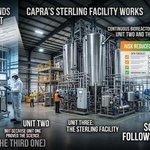
DPA Title III funds the pilot plant. It never funds the third one. Capra's Sterling facility works because continuous bioreactors de-risk unit two and three, not because unit one proved the science. Scale-up capital follows repeatability, not novelty.

1
15
Why BioFeedstock for Chemicals creates Supply Chain Resiliency! Saudi Arabia Under Fire: Oilfields, Refineries and Pipelines Hit Since the Iran War Began bioplasticsnews.com/2026/10/… via @Bioplasticsnews

1
26
Treasury's proposed rule to block U.S. biotech investment in China isn't really about restricting capital flow out. It's an admission that domestic biomanufacturing capacity is now a national security asset.
bhfs.com/insight/u-s-treasur…

20
Scaling biochemicals with the Department of War, by @aryelipman arye.substack.com/p/scaling-…

1
2
62
Bio-based chemicals don't win by matching petroleum's price. They win when the plant sits next to the feedstock and skips the freight, the middlemen and the port bottlenecks baked into the oil model. That's the real cost curve.

Primient's iPROOF confirms what we underwrite every day: the valley of death isn't a science gap, it's a manufacturing gap. Fowler's point stands: technical risk, cost validation and investor fatigue hit together at scale, not separately. agfundernews.com/primients-i…

Bio-isoprene only matters if it clears the same price floor as petroleum isoprene. Visolis hit that bar with Zeon on synthetic rubber, which is why the deal is a market signal, not a sustainability story.
The U.S. Treasury Department on Thursday proposed to expand existing outbound investment restrictions out of national security concerns, in a move set to further decouple venture capital ties between the U.S. and China.
The proposed regulation widens the scope to prohibit Americans from investing in certain areas of semiconductor and microelectronics technologies such as high-bandwidth memory chips, as well as all AI systems (or SI systems in the White House’s lingo) in several countries including China, Russia, North Korea, Venezuela, and Cuba. The existing rule only prohibits American investments in AI systems that use computing power above a certain threshold, and doesn’t strictly prohibit investments in AI applications or AI systems developed for robotics.
The proposed rule, which is open to public commentary until December 7, also seeks to restrict transactions in hypersonic systems and biotech, two sectors that aren’t covered by the existing rule that took effect in early 2025.
Treasury said the proposed rule was based on direction from Congress in the Comprehensive Outbound Investment Security Act, passed as part of the Fiscal Year 2026 National Defense Authorization Act. By Jing YangSource: The Information
1
31

ORNL just told the industry the quiet part: bioindustrial scale-up is not a biology problem, it is a manufacturing systems problem. Its new BioMADE membership bets on robotics, materials science and process engineering, not another strain improvement. That is the bottleneck we underwrite.
1
1
31
