

Life is like a camera. Just focus on what's important & capture the good times, develop from the negatives and if things don't work out, just take another shot.
London, England
Joined December 2009
- Tweets24.7K
- Following368
- Followers36.1K
- Likes24.6K



Knowledge of London retweeted
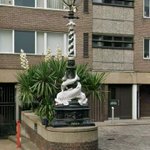
The solitary dolphin lamp post on Southwick Street, Sussex Gardens, London, is a 1964 replica of the iconic 19th-century Thames Embankment street lights. Located outside the Devonport apartment block on the Hyde Park Estate, it stands out both for its inland residential setting and its distinctive white-paint.

Knowledge of London retweeted

Disappointed that plans to demolish 68–69 Fenchurch St have been approved.
We objected to the loss of this unlisted Edwardian building, which makes a positive contribution to the Lloyd's Ave Conservation Area. We called for a conservation-led approach to adapt and reuse instead.

Granny Dripping Steps, West Hampstead.
Tucked beside West Hampstead tube station, this graffiti-covered Victorian railway footbridge features an unusual layout with wide gaps between the steps and a curious nickname linked to a 19th-century music hall song.
Other local folklore stories attribute the name to an older woman or crossing sweeper around the turn of the 19th century who sat on or swept the steps and ate bread and dripping.


Deptford Borough War Memorial, a Grade II-listed monument located at the corner of Lewisham Way and Upper Brockley Road in New Cross, Deptford (SE4), unveiled in 1921.
Crafted from Portland stone, it features a tapering octagonal column topped with a carved flame, flanked by carved figures of a soldier and a sailor.
The two figures of the servicemen leaning against the east and west sides of the pedestal sculpted by W. W. Wagstaff, based in Kingston-upon-Thames.
William Richards of Brockley designed and built the main monument.


The Tooting Broadway lamp post is a Grade II listed Victorian cast-iron structure located directly outside Tooting Broadway Underground station in South London.
Dating to the late 19th century, it is widely believed to have been cast by the renowned Walter Macfarlane foundry (Saracen Foundry) of Glasgow.
This three-in-one street monument works as an Underground Toilet Ventilation with perforated panels around its chunky base, acted as an air vent for the former subterranean public lavatories directly beneath the pavement.
Street Lighting with Its multi-branched upper tier holds five restored, functioning gas lamps.
Thirdly the decorative Victorian fingerpost signs extend from the middle of the column, pointing travellers toward Croydon, Wimbledon, Wandsworth, and London.

The "Postbox-Eating Tree" (West Kensington). Located at Fitzgeorge Avenue (W14), this century-old Edward VII pillar box is slowly being enveloped by the trunk of a massive London plane tree, though it remains fully functional.


Out of Order (Kingston upon Thames). Sculptor David Mach's iconic 1989 installation on Old London Road features 12 red K6 boxes arranged to look like toppling dominoes.

Knowledge of London retweeted
"Atlantes Holding Up Fresh Air" (82 Mortimer Street):
One of the most eccentric architectural details, designed by the highly individualistic Arts and Crafts architect Arthur Beresford Pite in 1896, the building's facade features a striking window treatment.
Flanking a prominent upper-level window arch, you will find deeply expressive, Michelangelesque stone sculptures of an Atlante (male figure) and a Caryatid (female figure). Because of how the window frame is recessed, they humorously look as though they are straining to hold up nothing but empty air.


The solitary dolphin lamp post on Southwick Street, Sussex Gardens, London, is a 1964 replica of the iconic 19th-century Thames Embankment street lights. Located outside the Devonport apartment block on the Hyde Park Estate, it stands out both for its inland residential setting and its distinctive white-paint.
Knowledge of London retweeted
Some things are hidden in plain sight like the miniature architectural model on Maiden Lane in Covent Garden. The 1998 public sculpture by artist Eamonn Hughes, is tucked away in an alcove in the courtyard of 18–20 Maiden Lane (near the JMW Turner birthplace plaque).
The carved stone piece depicts a miniature architectural curiosity with tiny columns, archways, and steps. If you look closely behind the columns on the bottom left, there is a tiny carved figure of a woman walking out of a doorway.


Knowledge of London retweeted
The Lloyd's Building in London celebrates its 40th birthday today, 18 November 2026. Officially opened by Queen Elizabeth II on 18 November 1986, the landmark headquarters at 1 Lime Street is marking four decades at the centre of the global insurance market.
I must admit the building has grown on me over the years. When it was first built we used to call the distillery as it looked like a brewing hub with all the pipe on the outside.

Knowledge of London retweeted
The distinctive horse-head bollards located on Gutter Lane in the City of London serve as a direct visual tribute to the Worshipful Company of Saddlers.
When the modern office buildings and pavements along Gutter Lane were developed, these custom, black-painted cast iron bollards topped with horse heads were installed to delineate the pedestrian walkways. A nod to the area's deep equestrian and trade history of the Worshipful Company of Saddlers.


The Lloyd's Building in London celebrates its 40th birthday today, 18 November 2026. Officially opened by Queen Elizabeth II on 18 November 1986, the landmark headquarters at 1 Lime Street is marking four decades at the centre of the global insurance market.
I must admit the building has grown on me over the years. When it was first built we used to call the distillery as it looked like a brewing hub with all the pipe on the outside.
The old railway wall at Scarsdale Place (W8) is a surviving Victorian retaining wall built around 1867–1868 for the cut-and-cover railway cutting leading south from High Street Kensington Station.
Before the railway arrived, the site formed the eastern boundary and garden wall of Scarsdale House, a 1690s manor owned by the Curzon family (Barons Scarsdale).

Knowledge of London retweeted
The Museum 'Tom & Jerry' Mummies
A bizarre relic recovered from the local vaults can be viewed at the London Museum Docklands. Affectionately nicknamed "Tom and Jerry," these are the mummified remains of a late-19th-century cat and rat. Cats were routinely kept in the Wapping and Docklands warehouses to control pests, and this particular pair became trapped and perfectly preserved between bottles of quicksilver (mercury) in the warehouse vaults.

The Boot pub on Cromer Street in Bloomsbury is famously featured in Charles Dickens 1841 historical novel Barnaby Rudge as the headquarters for the anti-Catholic Gordon Rioters of 1780. Local tradition also holds that Dickens was a regular patron of the tavern himself.
A tavern has existed on this site since the late 17th or early 18th century, originally operating as The Golden Boot. Back then, the building stood surrounded by open fields rather than dense city streets.
The current building dates from 1801. A golden boot sign has existed here in some form since at least the late 17th century, though pub signs are routinely replaced, repaired, or repainted over centuries rather than surviving untouched from 1690.


Knowledge of London retweeted
In June 1944, a German V-1 flying bomb ("doodlebug") exploded in the middle of the road directly outside the front entrance of Bush House, Aldwych. The blast killed 46 people in the street, blew out hundreds of windows, and severely damaged the building’s monumental portico.
Directly above the main Aldwych entrance stands a prominent portico featuring two massive stone statues sculpted from Indiana limestone by American artist Malvina Hoffman.
The two figures represent Great Britain and the United States, holding a torch of progress together under the inscription, "To the friendship of English speaking peoples".
The V-1 bomb blast completely blew off the left arm of the statue representing America.
In a twist of wartime symbolism, the statue’s right arm remained firmly connected to the stone torch and the statue of Britain. Londoners at the time viewed this as a powerful sign that despite the devastation of the war, the alliance and friendship between the two nations remained unbroken.
The American statue remained missing its arm for over 30 years. In the 1970s, an American executive from the Indiana Limestone Company noticed the battle-scarred, one-armed statue while visiting his daughter in London. He arranged for his company to donate a matching block of stone and dispatch a specialist stonemason. The arm was finally carved and reattached in 1977, just in time for Queen Elizabeth II's Silver Jubilee.
