
The world's leading venue for collaborative research in theoretical computer science. Follow us at https://www.teapaw.org/t.co/KvcuGI7WM0.
Berkeley, CA
Joined January 2018
- Tweets1.5K
- Following356
- Followers10.3K
- Likes830





Simons Institute for the Theory of Computing retweeted
1/2 “The entirety of the current AI boom is driven by this observation that many properties in AI scale in really surprisingly lawful & predictable ways,” said @jaschasd of @AnthropicAI, at the Simons Institute. Video: simons.berkeley.edu/talks/ja…

1/2 “The entirety of the current AI boom is driven by this observation that many properties in AI scale in really surprisingly lawful & predictable ways,” said @jaschasd of @AnthropicAI, at the Simons Institute. Video: simons.berkeley.edu/talks/ja…
2/2 Does AI misbehavior also scale predictably? Can we, “write down some nice power law or similar equation for [misbehavior] as we can for loss or other properties of AI,” said @jaschasd at the Simons Institute workshop on Trustworthy AI: From Hallucinations to Reliable Autonomy

2
393
Simons Institute for the Theory of Computing retweeted
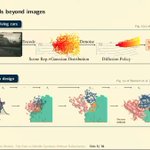
"Diffusion models are used way beyond generating images. They are used to generate diffusion policies for self-driving cars, even protein design. The application area for diffusion models is ever expanding," said @Grigoris_c of @UWMadison during his talk at the Simons Institute.


"Diffusion models are used way beyond generating images. They are used to generate diffusion policies for self-driving cars, even protein design. The application area for diffusion models is ever expanding," said @Grigoris_c of @UWMadison during his talk at the Simons Institute.
"How do hallucinations differ in discrete systems, [such as] graphs, text domains than in continuous domains," said @Grigoris_c, at the Simons Institute workshop on Trustworthy AI: From Hallucinations to Reliable Autonomy. "This is exciting for me." Talk: youtube.com/watch?v=Cx47YnPm…

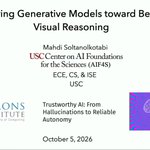
1/ 3 "The progress in reasoning models has been really crazy recently...But the frontier is quite jagged. Despite all of this progress, there are some very weird shortcomings that still exist, even in the latest models," said Mahdi Soltanolkotabi of @USC at the Simons Institute.

2/3 "If you have simple, visual reasoning questions...the models tend to get them wrong," said Mahdi Soltanolkotabi of @USC at the Simons Institute workshop on Trustworthy AI: From Hallucinations to Reliable Autonomy. Video: simons.berkeley.edu/talks/ma…

1
3
694
3/3 For example, OpenAI's Astra 6.1, when prompted to place 31 Stanford tree mascots in front Sather Gate in Berkeley, produced an image with 33 mascots, and a misplaced Campanile behind the gate. "Geographically, it's not possible," said Mahdi Soltanolkotabi of @USC.

452
Simons Institute for the Theory of Computing retweeted
2/2 Their task: to discuss the immediate future of theoretical computer science in light of the challenges posed by AI. Read a report of that closed-door meeting, in the Polynomial Times (see Theoretical Computer Science Meets Its AI Moment, page 3): simons.berkeley.edu/PolyTime…


Simons Institute for the Theory of Computing retweeted
1/2 The day after OpenAI dropped a bombshell about "a solution to the Navier–Stokes existence and smoothness problem," 32 theoretical computer scientists met for a closed door meeting (that had been planned for months) at the Simons Institute for the Theory of Computing.

1/2 The day after OpenAI dropped a bombshell about "a solution to the Navier–Stokes existence and smoothness problem," 32 theoretical computer scientists met for a closed door meeting (that had been planned for months) at the Simons Institute for the Theory of Computing.
2/2 Their task: to discuss the immediate future of theoretical computer science in light of the challenges posed by AI. Read a report of that closed-door meeting, in the Polynomial Times (see Theoretical Computer Science Meets Its AI Moment, page 3): simons.berkeley.edu/PolyTime…
Join us for two special events this month:
Quantum Industry Day | Wednesday, 11/18
simons.berkeley.edu/workshop…
Industry Day | Thursday, 11/19
simons.berkeley.edu/events/t…
Space is limited, so register early!

3
864

@nytimes story out today on the OpenAI breakthrough on the Exponential Time Hypothesis, featuring our friends @RussellImpaglia and @rrwilliams.
nytimes.com/2026/11/06/scien…

Our earlier post should have mentioned that @AnthropicAI announced on the same day that it had independently disproven ETH.
More coverage: science.org/content/article/…

260
“Immediate, practical applications? There aren’t any,” Dr. Williams said.
“This could lead to better A.I.,” Dr. Impagliazzo said, “in all sorts of ways.”
1
189
Congratulations to our senior scientist, @jasondeanlee and all the other worthy recipients!

Congratulations to the nine faculty receiving CDSS Machine Learning Research Awards! @UCBStatistics @Berkeley_EECS
@Cal_Engineer @UCBerkeley
🔗 Read more: bit.ly/4sHn3Sd
#MachineLearning #Statistics #ComputerScience #ResearchAwards #PeopleOfCDSS

ALT Grid of CDSS Machine Learning Research Award recipients Serina Chang, Avi Feller, Amanda Coston, Ryan Giordano, Jason Lee, Sewon Min, Narges Norouzi, Joseph Gonzalez, and Nikita Zhirotovskiy. Text reads: Nine CDSS faculty receive Machine Learning Research Awards.
14
862