

AI engineering, distilled. Agents, LLM systems, MLOps & infra architectures, papers, and tools worth your time.
Italy
Joined January 2016
- Tweets503K
- Following28.4K
- Followers171K
- Likes2K


Building AI Agents with OpenAI is worth a look. Learn to deploy AI assistant systems with Streamlit. aiflx.xyz/courses/building-a… #AD #AIAgents #OpenAI

1
517
Explore AI Automation & Vibe Coding: Build Real Tools Without Code. Build a Telegram alert bot. aiflx.xyz/courses/ai-automat… #AD #Automation

372
For your QA toolkit: Testing Machine Learning and GenAI Systems. Design API automation tests for ML model endpoints. aiflx.xyz/courses/testing-ma… #AD #SoftwareTesting

448
Take a look at Advanced Prompt Engineering for All. Get hands-on practice with LlamaIndex. aiflx.xyz/courses/advanced-p… #AD #PromptEngineering

394
Explore Build Intelligent Agents Using DeepSeek & N8N. Route AI-classified data from PDFs and emails into Google Sheets. aiflx.xyz/courses/build-inte… #AD #n8n #AIAutomation
477
Explore Jetson Nano Starter to Pro - A Computer Vision Course. Learn to integrate multiple cameras with DeepStream. aiflx.xyz/courses/jetson-nan… #AD #ComputerVision

2
600
Consider LLMs, RAG, MCP, LangGraph & Multi-Agent Systems. Learn to build document analysis systems through hands-on projects. aiflx.xyz/courses/llms-rag-m… #AD #RAG

2
529
Machine Learning FLX retweeted

Introducing Multica
Agent platform of 2027, free and open-source.
github.com/multica-ai/multic…


Agent platform of 2027.
This is the end game. This is the blueprint for the one and only application layer software that will exist. Every other software will effectively become databases for this layer, the everything agentic operating system for the million agent swarm to work on top of.
This is obviously the end game vision for the application layer of ChatGPT and Claude. I have reasons to believe that an independent company will own this product layer. But most ADE, "enterprise agent platform", or vertical saas companies, are focused on the wrong things far too narrowly, not technically competent, and do not have the product / technical vision to see this inevitable future.
The correct agent platform that wins will function like the base of a garden, from which customers will plant their unique "seeds" to grow their own plants and trees, managed and evolved by agents, humans, and signals from the sensors of the business. This presents a clearer picture than "factory of a factory" imo.


Machine Learning FLX retweeted

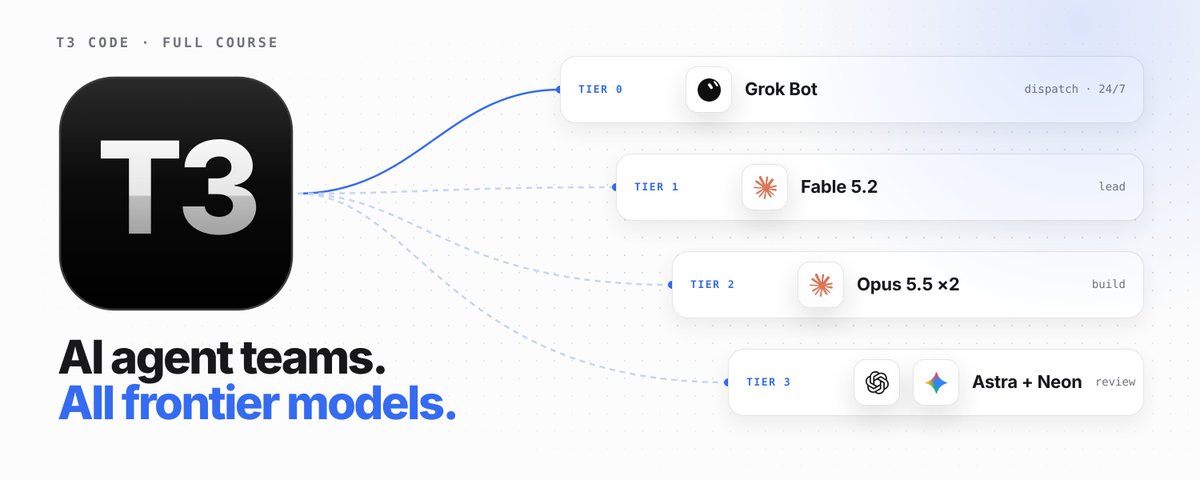
T3 Code founder just shared one prompt that builds a multi-agent team with Opus 5.5 + Grok Bot + Fable 5.2 + Gemini 4 Neon + GPT-6.2 Astra.
It's f*cking unreal…
send it to your T3 or GrokBot and thank me later. Then read the full roadmap with examples below.




Machine Learning FLX retweeted

Prompt, context, harness & loop engineering, clearly explained!
An agent is a while loop with four layers of engineering wrapped around it:
- Prompt engineering
- Context engineering
- Harness engineering
- Loop engineering
Each one wraps the last, and the model sits in the middle, so none of them compete with the others. Instead, they just zoom one level further out.
> Prompt engineering:
This defines the input the model sees on one call, often composed of a role, instructions, examples, and an output format.
The techniques here alter the internal computation and reasoning the model goes through due to the wording it sees:
- Chain-of-thought makes it work in steps before answering
- Few-shot examples define the format and the edge cases
- A JSON schema or XML tags make the output parseable by code
- Self-consistency samples a few chains and takes the majority
> Context engineering:
It's everything the model sees on a turn, not just the prompt. That includes the query, retrieved docs, memory, prior turns, and tool outputs from earlier steps.
The window is finite and fills up fast, so the engineering work is to rank inputs and cut everything that isn't pulling weight.
You do this by:
- Retrieving only the chunks relevant to the query, then reranking them
- Keeping key facts out of the middle, where accuracy drops
- Summarizing old turns, evict stale outputs, push big blobs to files
> Harness engineering:
It's the code around the model that defines the tools, parses the calls, retries on failure, and can route work to sub-agents so one handles retrieval and another handles code.
A verifier then grades the result by running tests, validating a schema, etc.
Prompt and context involve getting one call right. The harness involves everything that has to happen around that call for it to run in a real system.
> Loop engineering:
In the usual setup, you manage the outer loop, i.e, you write a prompt, read the turns the agent runs, write the next prompt, and repeat, while catching failures.
This layer hands that job to the agent itself. It kicks off on a schedule or an event, and runs many turns with no prompt in between.
A loop inherently doesn't know when it's finished. An agent can report that it's done and halt while the tests still fail. So the stop can't be the agent's word, but rather it has to be a real signal, like:
- A turn and token cap to stop stuck runs
- A no-progress detector to catch repeated calls
- A completion check to verify the goal with a separate model or a deterministic test
By this layer, you're operating on the whole run, so the engineering moves from writing each prompt to setting the goal and the stop conditions up front and letting it run.
A longer run also makes the cost of the layers underneath it grow.
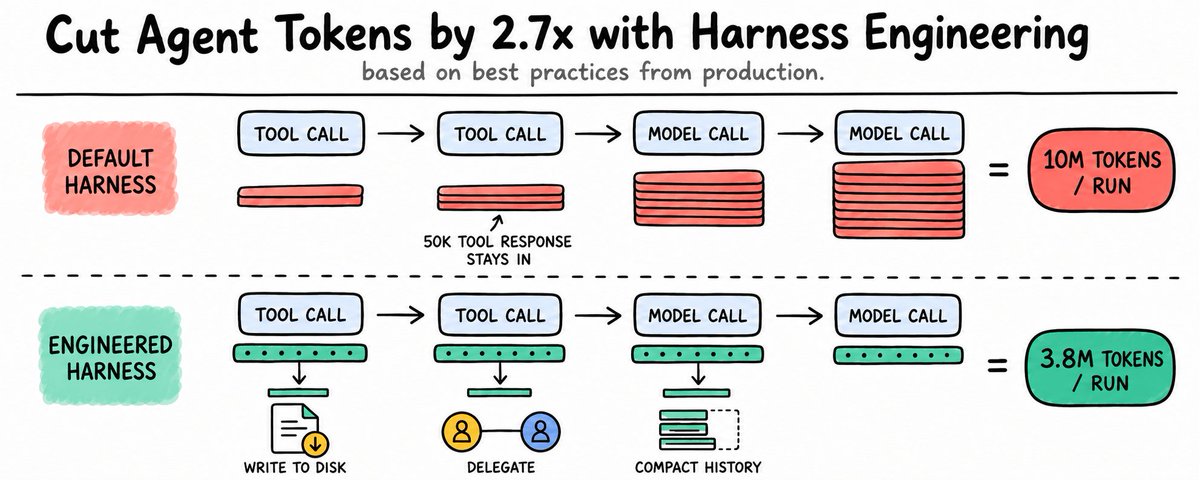
When a tool returns a 50K-token response and nothing removes it, the model reads it again on every later call. Over a loop of twenty steps, one response turns into hundreds of thousands of tokens.
I wrote a full breakdown of where an agent's tokens actually go and how a harness keeps context flat, using TrueForge, an open-source harness that turns an LLM into a working agent.
GitHub repo: github.com/truefoundry/truef…
(don't forget to star it ⭐ )
It covers offloading large tool outputs to files, subagents for context isolation, Code Mode for multi-tool joins, and compaction.
It also has a benchmark of three harnesses on the same 14 tasks, where TrueForge reached the same answers on about 40% of the tokens Claude Managed Agents used.
You can read my full article below.

Machine Learning FLX retweeted

Supermicro and NVIDIA AI Factories combine high‑performance GPU compute, AI software, high‑speed networking, and scalable storage to accelerate data‑center‑ready AI workloads.
Agentic AI with LangGraph, CrewAI & AutoGen is worth a look. Practice building AI applications with Python. aiflx.xyz/courses/agentic-ai… #AD #Python

1
642
Try Fine Tune BERT for Text Classification with TensorFlow. Work through a 2.5-hour guided project. aiflx.xyz/courses/fine-tune-… #AD #NLP

1
701
Try Building LLMs with Hugging Face and LangChain. Learn to build RAG pipelines with FAISS. aiflx.xyz/courses/building-l… #AD #LLM #LangChain

Jetson Nano Starter to Pro - A Computer Vision Course is worth a look. Learn to integrate multiple cameras with DeepStream. aiflx.xyz/courses/jetson-nan… #AD #ComputerVision
Fine-Tuning Transformers with Hugging Face is worth a look. Build an end-to-end sentiment analysis system. aiflx.xyz/courses/fine-tunin… #AD #HuggingFace #NLP
755
Large Language Model Operations (LLMOps) is worth a look. Explore open source LLM management on platforms including Databricks. aiflx.xyz/courses/large-lang… #AD #LLMOps

Explore Agentic AI, Generative AI, LLMs, RAG & MCP. Build document analysis systems with Python. aiflx.xyz/courses/agentic-ai… #AD #Python #AgenticAI

1
1
822
Vibe Coding with GitHub Copilot is worth a look. Practice using Copilot to create tests. aiflx.xyz/courses/vibe-codin… #AD #GitHubCopilot #Coding
